
 RRL
 Freenote Cloth
 Merz B. Schwanen
 Red Wing
 Hiroshi Kato
 Schott NYC
 UES Clothing
 Dehen1920
 Polo Ralph Lauren
 West Major
 Shinola
 Amundsen
 MOSCOT
 Peregrine
 Shangri-La Heritage
 Astorflex
 Iron and Resin
 Ampal
 Jungmaven
 Big D Speedshop
 Fulton & Roark
 Howler Bros
 AO Eyewear
 Rails
 Ranger Station
 Bellroy
 Filson
 Sabah
 Birdwell
 Secrid
 Taschen
 Schwood
 Bradley Mountain
 American Trench
 Studebaker Metals
 Unmarked
 Texas Standard
 Rhythm
 Oxford Pennant
 Gestalten


 Girls of Dust
 Road to Nowhere
 Filson
 Marine Layer
 Rails
 THE GREAT.
 Shinola
 Diadora
 Astorflex
 Retro Brand

American Selvedge Is Back
For the first time in nearly a decade, selvedge denim is being woven on American soil. The looms doing it are the same ones that made your grandfather's Levi's — and their road back was anything but straight.

Draper X3 shuttle looms at work — the same machines now running again at Mount Vernon Mills in Trion, Georgia.
01 — The Mill That Made Levi's
In 1905, Cone Mills opened its White Oak plant in Greensboro, North Carolina. For the next 110 years it wove denim for Levi's, Wrangler, and most of the storied American brands — the official supplier of selvedge to the companies that defined the blue jean. When it closed at the end of 2017, it was the last remaining commercial producer of selvedge denim in the United States. A lot of people assumed the legacy of American-made selvedge went out the door with it.
Selvedge — "self-edge" — is denim woven on old shuttle looms. The shuttle carries one continuous weft thread back and forth across the warp, which creates a tightly finished edge that won't unravel. Modern looms fire each weft thread through and cut it, leaving a frayed edge. The old way is slower — a fraction of the pace — but the fabric has character no modern machine reproduces.
02 — The Long, Fraught Journey
After White Oak closed, the looms went to Vidalia Mills, an ambitious startup in Vidalia, Louisiana, that promised a glorious return to form. It never quite came to pass. When Vidalia's assets went up for auction, the looms' fate was genuinely uncertain — financial firms were involved, and plenty of people assumed the machinery would end up in storage or scrap.
Finished rolls — Mount Vernon began shipping its first American-woven selvedge this month.
Enter Mount Vernon Mills. Founded in 1845, celebrating its 180th anniversary, it's one of the longest-running textile manufacturers in the country — a self-described "quiet giant" in Trion, Georgia, that started making denim in the 1970s and already weaves for Wrangler and Carhartt. In partnership with KaKa Cotton, the New York firm that owned the equipment, Mount Vernon bought the lot: 45 Draper X3 shuttle looms — some dating to the 1950s — plus 45 Picanol President shuttle looms for good measure.
They announced it the way you'd hope: an Instagram video of a semi truck backed into a loading bay, its cargo shrouded in a white plastic sheet.
Getting them running was the hard part. Pickers scoured barns and warehouses for spare parts — bins of springs and levers that hadn't been manufactured since the 1970s. A crew of technicians from Greensboro decamped to Trion to teach Mount Vernon's staff how to keep antique machinery alive. As GQ put it this month: "It has been a crazy ride."
03 — Elvis, Aretha, Lucille
The selvedge ID — flip the cuff and the self-finished edge tells you what you're looking at.
About 20 of the 45 Draper looms are operational now, and each one has been christened with the name of a golden-era American cultural icon: Elvis. Aretha. Lucille. The mill is starting with two standard fabrics, and brands are already lining up — Mount Vernon's marketing director alludes to bigger deals with high-profile clients he can't name yet.
One of the early converts is Mike McLachlan, founder of the Connecticut brand Manresa, who's burning through his last yards of Japanese selvedge to make the switch. His reason is about character: most modern selvedge mills lean toward neppy, slubby, heavily textured denim. Mount Vernon's is the opposite — flat, uniform, the way Levi's denim actually looked in the middle of the century. "It's as traditional as it gets," he says.
"I'm going to wear them every day, so nobody's ever going to catch up to me in terms of my fade."
— Mike McLachlan, on his prototype Mount Vernon 207s
04 — Why It Costs What It Costs
The price of selvedge was never about the cotton. It's about the loom time. Antique shuttle looms weave at a fraction of modern speed. The yarn is rope-dyed — dipped so the indigo sits on the surface and the core stays white, which is exactly what creates those high-contrast fades. And the fabric comes off the loom narrow, so there's more waste per pair. Three times the labor, three times the price. That's the deal, and it was the deal in 1962 too.
What it means for the shelf: right now we've got Japanese selvedge — Freenote weaves theirs at the Kaihara mills in Japan, RRL washes theirs down to look like 1952. And for the first time in a decade, there's an American option coming back: flat, uniform, mid-century denim off the same looms that wove the originals. When American selvedge jeans hit the shelf, you'll hear about it here first.
Come feel the difference at Cave and Post.
caveandpost.com
Sources: "America Is Officially Back in the Selvedge Denim Business," Jeremy Freed, GQ, Oct 16, 2026; eTextileCommunications; AM 1180 Chattooga; Heddels. Loom photograph via Denim Hunters (Draper shuttle looms at Cone Mills White Oak).
Read more
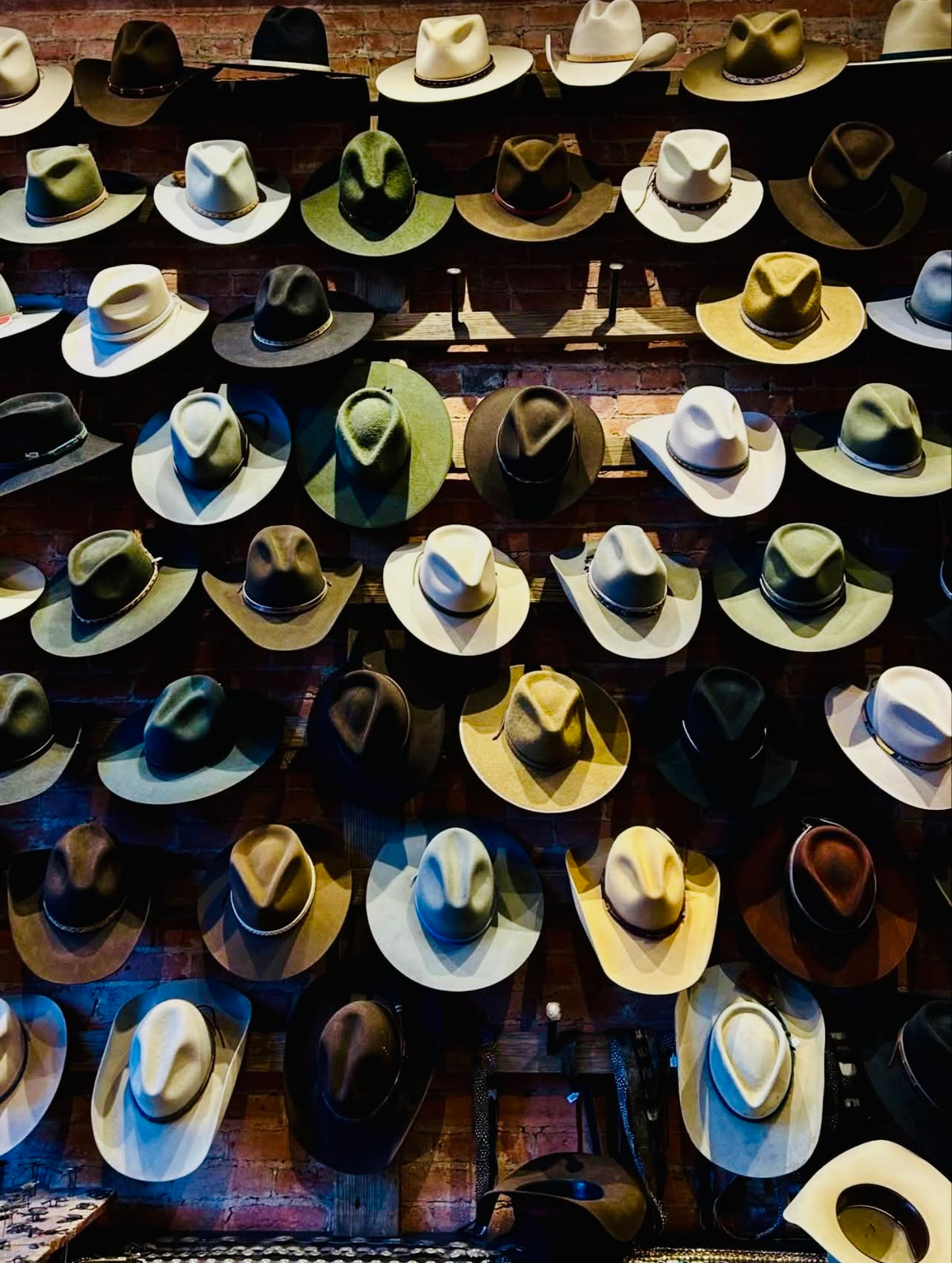
Where Cowboy Hat Crowns Got Their Names
Every crease in a cowboy hat crown means something. Most of them are named after the men who wore them first — ranchers, movie stars, gamblers, and one fictional Texas Ranger who changed hat histor...
Read more
PoloFest Tokyo, and the Labels That Made Polo
For three days last weekend, Harajuku became the capital of vintage Polo. The festival Ralph Lauren threw in Tokyo was really a family reunion — every label the company ever made, gathered under o...
Read more
Leave a comment
This site is protected by hCaptcha and the hCaptcha Privacy Policy and Terms of Service apply.